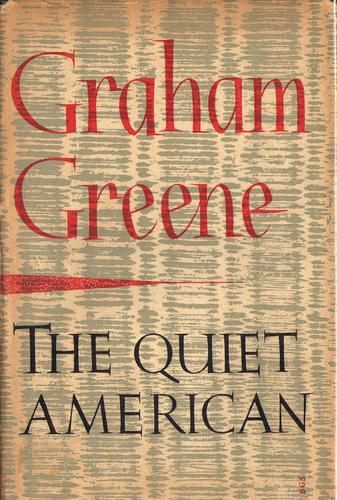
The Quiet American
When he saw a dead body he couldn't even see the wounds.
I have read so often of people's thoughts in the moment of fear: of God, or family, or a woman. I admire their control. I thought of nothing, not even of the trapdoor above me: I ceased, for those seconds, to exist: I was fear taken neat. At the top of the ladder I banged my head because fear couldn't count steps, hear, or see.
Do you think they know they are fighting for Democracy?
"They don't want Communism." "They want enough rice," I said.
I was afraid of losing love. Now I'm only afraid of losing Phuong.
If you had described this book to me in the abstract, I would have never picked it up to read. You could very cynically describe it as a cautionary morality tale about American interventionism told in a fairly flat, hectoring plot offset by a gratuitous and unbelievable love triangle that does little more than offset the protagonist lecturing every other character he meets, with of course the exception of him being lectured by a handful of other characters as well. This is not a particularly inaccurate description of the book, except, of course, the framing device in which we, in a particularly modern fashion, learn that the third member of the love triangle is dead in the book's opening pages, and we flash back to discover how it happened.
Now, that aside, I loved this book. I thought it was absolutely terrific. I had never picked up Graham Greene, perhaps for reasons of nominative determinism. His name evokes some of the more mannered, stately 20th century British writers who I generally avoid, and I was quickly disabused of any priors I had. This book is incredibly well crafted from start to finish, and so much of its delight for me was that it managed to put so much into its fairly slim word count without ever feeling rushed or overstuffed.
Greene talks about love and fidelity. He talks about nationalism and foreign policy. He talks about spycraft. He talks about all of this in an eerily present and modern sensibility. There is nothing about this book that ages poorly, except perhaps its treatment of Phuong, which you could perhaps do a waving away with a certain Straussian reading.
Last year for me was the year of Len Deighton, and I enjoyed Deighton's work up until a point, but did not exactly consider it high literature, just the right blend of genre and depth. This is something I could put next to Le Carré in terms of its gravity, but Le Carré was never able to really command levity or comedy and use them to his ends. Greene here does, even when the monologues get a bit long.