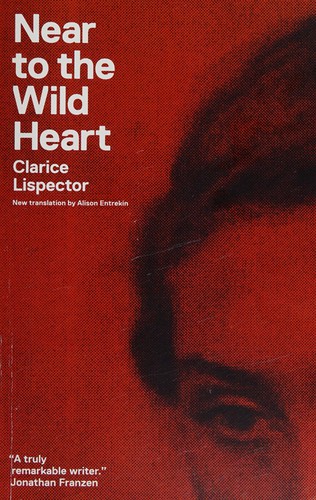
Near to the Wild Heart
Two friends, upon learning that I wanted to get into Clarice Lispector, advised me not to start with Near to the Wild Heart. Having now finished the book, I think I understand why.
The two parallels that come to mind — less in terms of style and message than in terms of how one situates the prose — are Murakami and Woolf.
Murakami is, to be clear, the much less stylistically successful of the two. But like Murakami, Lispector's work has been treated with a sense of otherness — not as a method of denigrating it, but to suggest that it sits outside its country's literary tradition. And while you can make a compelling argument that Murakami taps into a distinctly Japanese sense of alienation and ennui in the modern era — and, moreover, that much of his earlier writing is explicitly political — Lispector here is ethereal, barely attempting to give any hint or indication of where and how her protagonists live.
Part of this otherness — the sense of the story being completely untethered to any semblance of setting — serves contemporary reading well, in this age of autofiction and, for lack of a better term, idealistic narcissism. There is hardly a hint of whiplash going from Ben Lerner to Lispector.
Woolf I evoke for a handful of reasons. First: like Lispector, Virginia Woolf is often praised backhandedly, under the umbrella of feminist literature, or feminist modernism. But Woolf's goals — say, in To the Lighthouse — are directly oppositional to Lispector's. The Lighthouse is an argument toward the permeability of consciousness and shared existence, conveyed with empathy and perspective. Woolf uses the frame of modernism to talk about shared experience, and this pattern forms a lineage in which I can find much of my favorite writing. (See also A.S. Byatt's Possession.)
Lispector, conversely — at least in this book — is a solipsist. Her self-insert protagonist is the raison d'être of the entire prose, the sun about which every other character orbits. Any character not named Joana is given time and energy only insofar as they shed light on Joana. And the philosophy of the book — beyond its explicit cribbing of Spinoza — is an argument, if not quite in favor of this, then against the status quo that spawns it.
All that aside: this book makes me more intrigued to read the Lispector of her later years, while considerably less excited at the prospect of having found an author I can spend the next decade absorbing. Her biggest asset on display is the prose. Even through translation, her writing is beautiful and serrated, while never being Rococo. And considering her age upon writing this — and this is where the Woolf comparisons begin to feel unfair — one gets the sense of a young master in full control of what she wants to say and how she wants to say it, but who unfortunately does not yet have much at all to say.
One last note: the final chapter, a series of monologues from Joana, is indeed placeable among the highest echelons of modernism — beautiful and cryptic and self-indulgent all at once.