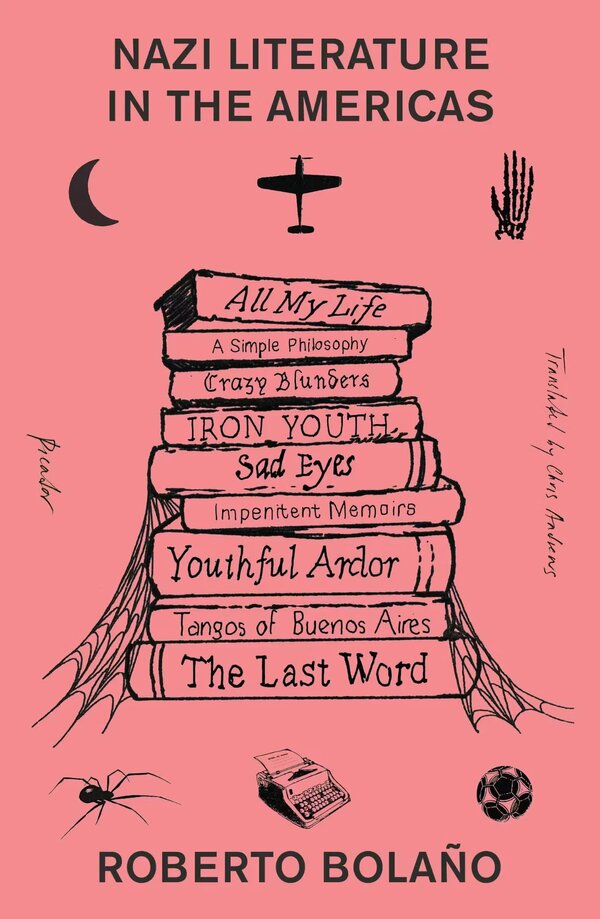
Nazi Literature in the Americas
Learn by fire.
One of the things that is so striking about Hitchcock is how even his objectively slighter works — taken in isolation, and attributed to some other respected director — would be absolute smash hits. Ten out of ten films.
I'm reminded of Hitchcock by Bolaño in reading Nazi Literature in the Americas. Not just because both men are fascinated by formalist structures, nor because both seem to draw from a deep wellspring of what violence against women means — and of the psychic reckoning that violence forces upon a community. But because this book, which is probably correctly described as one of his more middling and trivial works, was (and remains) so masterfully inventive and potent that I'm simply swept away.
The book's summoning not just of a bibliography, but of an entire extended universe around that bibliography, is of course fun — evocative of similar jaunts like the filmography of James O. Incandenza in Infinite Jest, or the ever-swelling apparatus of Pale Fire. But most clearly and explicitly, it recalls Bolaño's North Star: Borges (see Ficciones) — who, it should be noted, was an avowed admirer of Pinochet.
And so the intent of Bolaño's dry but vaguely warm descriptions of each author — their works, but most importantly their social scenes and foibles — is clear. To certain important people, the politics just didn't matter that much.
There's a set-up, punchline, set-up, punchline repetition to each entry (not unlike Calvino's Invisible Cities), saved from becoming grating by simple dint of Bolaño's incredible gift as a writer and cutting humorist. I am worldly enough to appreciate perhaps five percent of the snarky references to literary salons and cliques and the extant authors he name-drops; the rest are for those more in the know. But everything just worked.
Many of the stories, even if generally arch and satirical, contain cores of darkness. And whatever misgivings one can have about the relative triviality of what comes before, the final chapter — depicting Carlos Ramírez Hoffman, a pilot-poet who, as villains in Bolaño's work tend to do, murders many women — contains spare passages that fill you with a dread unlike anything I encounter outside of McCarthy. That sense of grim, warm dread as we entered that final chapter is what got me reminiscing about 2666.
All of this is to say: the message of this book is very clear. Art is amoral; evil can be mundane, and it can also be elemental; demons may not exist, but monsters live four blocks down from you.