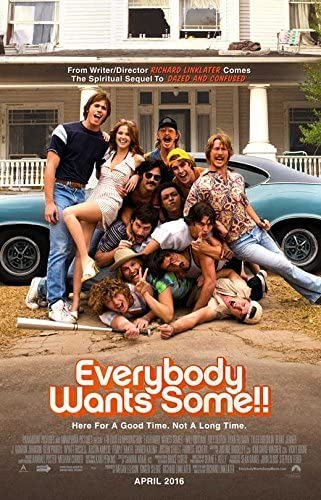
Everybody Wants Some!!
The single most pleasurable movie of all time is Soderbergh's Ocean's Eleven, and it achieves that status in order to try to convey what makes filmmaking uniquely magical: a sense of shared enchantment between the audience and the director, and the ecstasy of the latter pulling a heist on the former -- not (just) trickery, but the successful creation of an ornate and difficult craft. (See also The Prestige.)
Everybody Wants Some!!, conversely, generates pleasure as sheer by-product of its subject matter: what it's like on your first few days on campus as a freshman in college. Because those days are glorious and orgastic, so too is the feeling of watching the film; everything that the film is interested in conveying emotionally is downstream of its loyalty to conveying earnestly, as is often the case with Linklater.
The extent to which you find it legitimately a great piece of filmmaking (as everyone agrees that it's a fun time) is based solely on if you find its script earnest rather than hedonic. The highest praise I can give it is that my sensation upon watching it — first ten years ago, and then again today — was a resounding "yep, that's exactly how it felt." I went to college in 2009; I did not play for the baseball team; but I can still remember that exact sense of heightened reality that suffused my first few weeks of college, and it felt the exact same as watching this movie feels.
In this respect, it shares for me an unlikely honor with Donna Tartt's The Secret History, another piece of art which was almost entirely an act of memory-keeping by its creator about their undergraduate experience, and which I found spiritually resonant in a manner unlike any book about "being in college" before or since.
Linklater touches on a lot of aspects here, but the one that hits home for me the most is lampshaded by an exchange between our protagonist and Glenn Powell, in what ends up being his breakout role as Finnegan:
Jake
Look at us, man. The last three nights, we've danced at a disco, total mindless disco music, danced the Cotton-Eyed Joe in kicker attire, and here we are, punks for a night. It sort of begs the question about who we really are.
Finnegan
Are you insecure about the duck feet?
In Linklater's memory of college, the identity of the individual is thin and negligible and therefore mutable. What matters and what persists is the identity of the collective. Everyone can put on cowboy hats, but they'll still present themselves in exactly the same way.
(To the extent that I have any critique of the film, it's that Linklater is almost heavy-handed with a lot of this. I guess he feels the need to balance out the joy of the film with a bit of didacticism — no more evident than in the climactic final-night party of the day, a literal costume partty.)
Almost all of the performances in this film are great and lovely in their own way, because they match the specific version of the character they're trying to portray.
But there are two people in this film who deservedly became stars: Glenn Powell and Zoey Deutch, both of whom are not only unfathomably charming in the same way everyone from college is, but also sell their magnetism in a way that reminds me of the most charming people I knew in college: people whose air I was desperate and grateful to share.
This film ends with a scene and message as cloying and obvious as it is lovely: a professor writing on the chalkboard, the first day of history class: "Frontiers are where you find them."
To me — someone who spent most of his time in college in some brew of both proactive and reactive self-discovery and self-reinvention — this gets to the heart of the specific kind of experience being a freshman and an undergrad provides: a fractal sense of wonder in all the uncharted territory.
And now, more than a decade after having left campus, it is clearer to me than ever that success in my four years there can be measured — or perhaps divined — by the extent to which I felt comfortable surrendering myself to the act of discovery. Is this, perhaps, what Linklater is trying to say? More than anything else, experiences are shared, but discovery is private, and the joy in college is that it forces you to understand that you can't have one without the other.