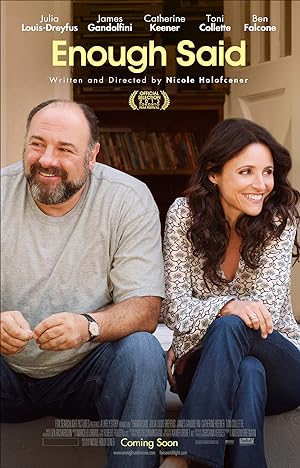
Enough Said
More by luck than by fate, most of the great protagonists of the last forty years of television have escaped forever being associated with the character they played. Jon Hamm's love of comedy means that, in a bizarre way, I think of him more as a guest on Comedy Bang Bang than as Don Draper — despite Mad Men being my favorite show of all time. Similarly, Bryan Cranston has such a well-enmeshed prior career in comedy and sitcoms that one can hardly fault him for being anything but one note.
But whether it's due to his relatively short career — made even shorter by his untimely passing — or to the singular power of the performance itself, I could not ever imagine James Gandolfini as anyone other than Tony Soprano.
Having only seen him in one other work — The Death of Stalin, in which everyone's playing a lot of dress-up and having a fun time but not trying particularly hard to be a good actor — I pulled up his filmography and found Enough Said, a film I vaguely remembered, largely for the circumstances of its release. Gandolfini passed after the movie had wrapped, but before it had finished editing. So I sat myself down and had a watch, and came away with the obvious conclusion that, armed only with these two performances: Tony Soprano and Albert, a reasonable person would assume that Gandolfini is the greatest actor of all time.
Often, when actors want to play against type, they do so by insisting upon themselves in one way or another — playing a part that seems somehow audacious, or other. Gandolfini here is none of those things. He is a kind guy, but not angelic. He is a bit of a slob, but not disgusting. He plays a human being with depth and nuance and warmth and sensitivity in a way that I don't think I've ever seen quite captured like this.
And that sense could be extrapolated to the film as a whole, which — if you can look past the central conceit and Julia Louis-Dreyfus's tendency to over-emote in the first two acts — is a bittersweet, funny, but deeply realistic meditation on what marriage does to people. Holofcener, who wrote the script, takes no prisoners, but she doesn't cast anyone as demons either. This is a story about two people who are flawed but not damaged. And her writing, mercurial as it is, Production notes indicate there was a lot of improvisational work done, which helped contribute to the naturalistic feel — and, in particular, to that final scene. was so good here that I immediately pulled up the rest of her credits to add to my backlog.
The film has its contrivances, and at times forces the point a little too heavily, as if each scene were rewritten to drive Louis-Dreyfus's character one step further into Flanderization. But it is an honest and entertaining portrayal of adults being adults — and when you layer on top of that one of the single greatest acting performances I've seen in my entire life, it's hard not to recommend it. Even if it feels, ultimately, a little slight.