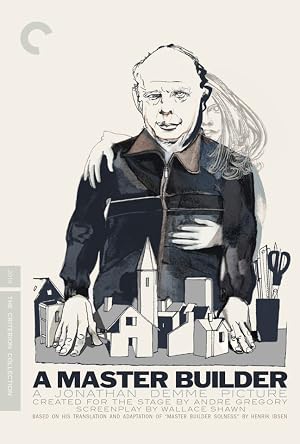
A Master Builder
Vanya on 42nd Street is, to date, my favorite film of the year. The more I revisit it, the more I suspect it might be one of my favorites of all time. So discovering that Wallace Shawn had attempted something of a spiritual successor — this time with Ibsen instead of Chekhov — was cause for celebration.
I'll admit that I'm more of a Chekhov man than an Ibsen one, but so much of what I loved about Vanya was not the script or the play itself; it was the interplay between the idea of theater and the idea of film. Vanya suggests a synthesis of the two forms through a shared goal of enchantment; the performances are great and the material is great, but all the fourth-wall stuff is meaningful on a level beyond devotion to the play itself.
A Master Builder comes two decades later, directed this time by Jonathan Demme (of Stop Making Sense and a slew of others.)
Demme appears to be going for something quite different -- or at least achieves (though that implies a certain intentionality) a much different effect. A Master Builder feels less like a sequel to Vanya and more like a spiritual rebellion against it: naturalistic performances are replaced with exaggerated ones; calm, steady, invisible direction is replaced with jarring cuts and off-putting close-ups; the warm, decrepit charm of the crumbling playhouse on 42nd Street is replaced with sterility and cold tones. Put simply: Vanya wants you as close as possible, and A Master Builder is insistent on pushing you away.
And consider myself pushed! There were more than a few moments during this film where I felt uncomfortable — not because I was grappling with something difficult, or reckoning with what the film was trying to tell me, but because everything simply felt so jarring in a way that seemed poorly architected rather than intentional.
(Hagerty was great, though.)
Update. My friend Jennifer emailed me to suggest that I listen to the Blank Check podcast episode about this, and as someone who only has room for one middlebrow film podcast in their life, I had been putting this off for quite some time — but I'm glad for her suggestion, as I finally took the plunge.
Not only because it was a very funny episode in which I had all of my priors confirmed, albeit in a more manic and eloquent manner than above, but because — of all people — their guest was John Hodgman, who delivered this point about both the play and the production altogether:
But only do I feel like Julie Haggerty really figures out what this is about when she says the thing. Yeah, my twin children died after this fire. My house burned down that I grew up in. But that's not what bothers me. What bothers me is the loss of all of the dresses that my mothers and grandmothers made, all this silent secret work that women do that never gets celebrated by putting a wreath on a phallic symbol or whatever in the middle of town. And two, these dolls that I had, these nine dolls that I even still as an adult played with these dolls when you were a grown up. She had a secret in her life that got burned up by her husband's ambition. It was just – that was the moment where I felt like, oh, this could be a – you could redo this play and it would be revolutionary to see today.